By Dickey Singh, CEO and Founder, Cast.app
It was the most automated customer success motion ever built — and the least felt.
It reached every account — and landed on no one.
It looked like coverage — and created distance.
It claimed personalization — and sounded like everyone else.
It was the smartest content the team had ever shipped — and it was wrong by morning.
The best of times for the health dashboard. The worst of times for the customer.
The health score is green. The inbox is full. The customer still feels unseen.
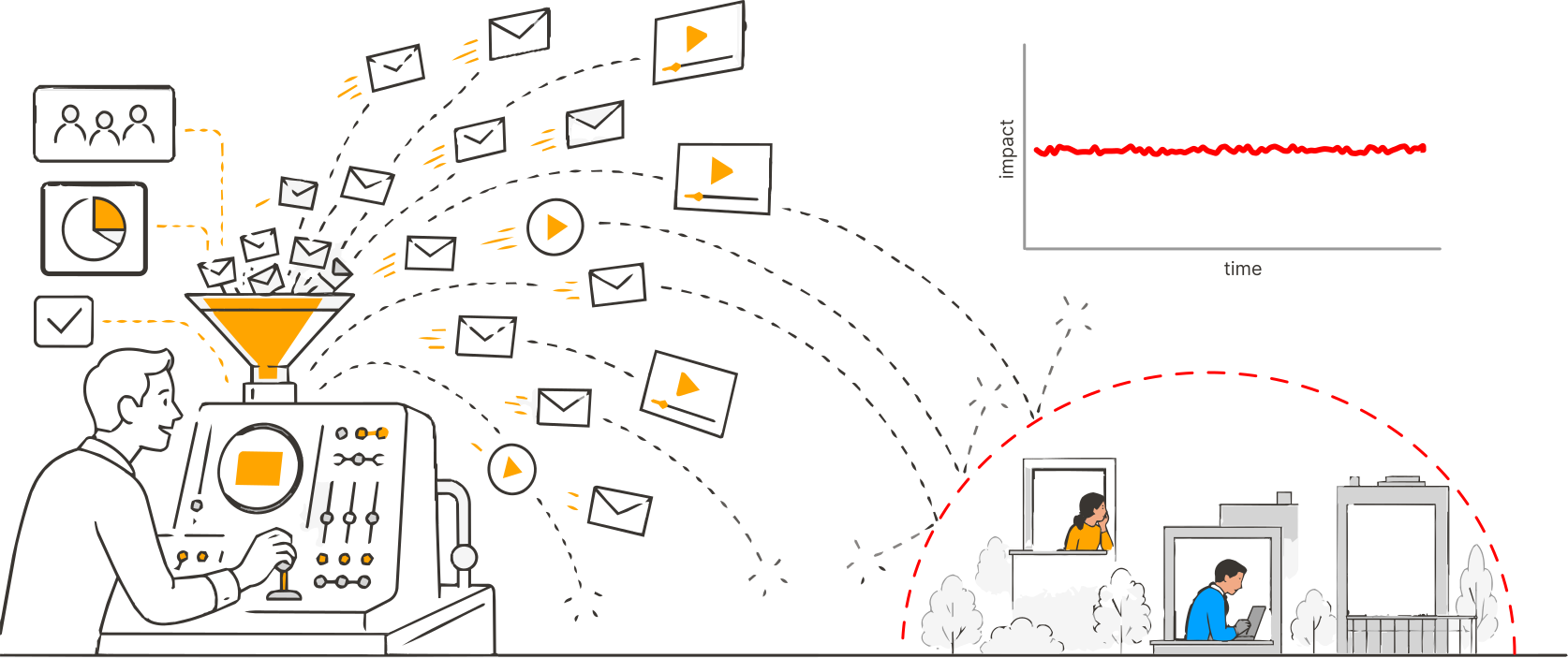
Every customer-success team runs a digital motion: the lifecycle emails, the onboarding sequences, the how-to videos that go out to the accounts no CSM has time to call. The old-school version of that motion is broadcast — one-to-many, the same content pushed at everyone.
An open is not an outcome. A touch is not a relationship. You reached their inboxes. You did not reach them.
Digital customer success comes in three forms.
One-to-many — broadcast. The same email and how-to video pushed at every account.
Many-to-many — community. Forums, advisory boards, and peer wikis customers build for each other.
One-to-one — a personal experience for each customer, at scale.
Two of these work. Community is valuable. One-to-one is where digital CS is headed. Broadcast is the one that is broken. The email and the video make a promise of help — and are not there when the customer's real question shows up.
Broadcast has exactly one real virtue, and it is worth conceding up front, because pretending otherwise is how vendor copy loses a skeptical reader.
Broadcast scales cheaply.
One email, one video, one campaign can be sent to ten thousand accounts at roughly the cost of sending it to one.
For a team staring at a CSM-to-account ratio that will not budge, that economics is not nothing.
But cheap scale without relevance is still not digital customer success.
The cost went to zero.
So did the value.
Picture a customer who finally opens the onboarding email three months late.
The champion who signed has moved on. Usage is flat. Renewal is six months out. The UI in the how-to video looks nothing like what they see on screen.
Their real question is no longer "How do I finish step three?"
It is "Where do we stand?" Then "Are we behind?" Then "What do we do next?"
Broadcast does not know those are the questions. So it explains step three.
What the customer needed was a current read of the account — where they stand now, what has changed, what matters next — and the freedom to ask against that live context.
Not a frozen answer from the day the campaign shipped.
A live read of the account, and answers grounded in that read.
Here is the thing static content cannot do:
Take the interruption.
When we analyzed more than two million minutes of real customer-success conversations, one pattern showed up everywhere: customers do not sit quietly through the prepared material.
They start asking questions early, often around the fourth slide, right when the content stops being an introduction and starts being about them.
That moment — the interruption — is where the relationship actually happens.
It is where trust is won or lost.
A templated email has no answer for the fourth-slide question. A recorded how-to video has no answer for it either.
The customer reaches the moment they care about. They have a question specific to their account, their data, their situation.
And the content just keeps playing.
Or worse, it just sits there in the inbox.
The one moment that matters most is the one moment broadcast is structurally incapable of handling.
Even live humans struggle here. In those same conversations, CSMs reached for some version of "let me get back to you" far more often than anyone would like. We wrote about that gap separately.
But a human at least eventually gets back to you.
A broadcast asset never does.
If a person with the account open in front of them sometimes cannot answer in the moment, a static artifact that cannot be interrupted cannot answer in the moment by design.
The second defect is time.
A how-to video is outdated the instant it finishes rendering.
The UI moved. The feature got renamed. The pricing changed. The screenshot in minute two now shows a button that no longer exists.
You shipped a snapshot into a world that had already moved on, and every day after, it drifts further from the truth.
Broadcast email ages the same way.
The "here's what's new" sequence written in Q1 is quietly wrong by Q2. It describes a roadmap that shifted, an integration that launched, a number that went stale.
The customer who opens it in month four is reading fiction about their own account.
Static content does not just fail to personalize.
It fails to stay true.
The standard critique of broadcast is that it feels impersonal.
So the standard fix is more personalization.
Merge tags. Dynamic segments. Industry-specific tracks. The customer's first name, company name, and logo stitched into a better version of the same one-way motion.
That work is not wrong. It is often useful.
It is just not enough.
Because the deeper defect is not only that the content is generic. It is that the content cannot respond.
A personalized email still cannot answer the question that shows up halfway through.
A personalized video still cannot adjust when the customer's data, product usage, renewal risk, or business priority has changed.
A personalized campaign still starts aging the moment it is launched.
You can personalize a dead end.
It is still a dead end.
That is why many digital CS programs create activity without creating a relationship. Opens, clicks, and plays may show that something was delivered.
They do not prove that the customer understood, trusted, acted, renewed, expanded, or felt seen.
The appearance of coverage is not the same as the substance of customer success.
The replacement for broadcast is not more personalization.
It is responsiveness — at the same scale broadcast gave you cheaply.
Something that reaches every account, takes the interruption, and answers the fourth-slide question in the moment with that account's real data.
Something generated fresh against the customer's current state, instead of shipped once and left to age.
Coverage without the dead zone.
One-to-one digital customer success at one-to-many scale.
That is a different kind of system than an email tool, a video library, or a nurture campaign. It is also most of what we have spent the last few years building.
But you do not need our product to act on the diagnosis.
You can audit your own motions against two questions:
When a customer brings a question to your broadcast content, what answers them?
And how true is that content the day after you ship it?
If the honest answers are "nothing" and "less true every day," you do not have customer success coverage.
You have the appearance of it.
Dickey Singh is the founder of Cast (cast.app), where the team is building agentic CS infrastructure for enterprise customers including HPE, Pure Storage, Cloudera, and CDK Global. Cast itself runs on agentic engineering — the team uses Cursor, Claude Code, Codex, and GitHub bots daily. Cast breaks the headcount cycle: more accounts no longer means more CSMs.


